Nous utilisons des cookies sur notre site web afin de vous fournir le meilleur service possible et d'améliorer encore notre site web. En cliquant sur le bouton "Accepter tout", vous acceptez l'utilisation de tous les cookies. Vous pouvez limiter les cookies utilisés en cliquant sur "Accepter la sélection". Vous trouverez de plus amples informations et une option pour révoquer votre sélection dans notre politique de confidentialité.
Ces cookies sont nécessaires pour la fonctionnalité de base. Cela vous permet de vous inscrire sur notre site web et notre forum ou de commander des produits avec notre boutique en ligne.
Avec ces cookies, nous collectons des données d'utilisation anonymisées pour notre site web. Par exemple, nous pouvons voir quel contenu est intéressant pour nos visiteurs et quelles résolutions sont utilisées. Nous utilisons ces informations pour optimiser notre site web et vous offrir la meilleure expérience utilisateur possible.
plus
→ Go directly to the PCAN-Repeater DR or PCAN-Router Pro
Reliable CAN communication is essential for ensuring the safe and efficient operation of electric vehicles. When communication between electronic control units (ECUs) is disrupted, vehicle performance and reliability can be severely affected. To resolve recurring communication failures, PEAK France worked with Kremer to analyze the existing CAN network and implement a solution based on the PCAN-Repeater DR and PCAN-Router Pro. This study presents the customer’s application, the root causes of the network instability, and the implemented communication architecture.
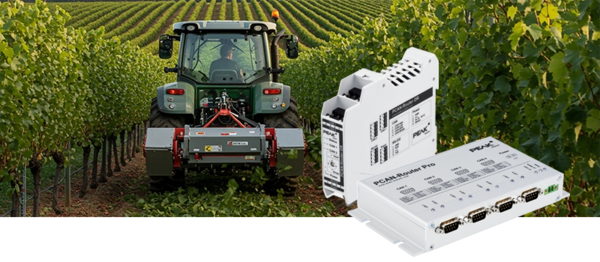
Kremer Energy, which specializes in the design of electric tractors, was experiencing random CAN network failures that caused a complete loss of communication between the vehicle’s ECUs. These communication interruptions temporarily rendered the vehicle inoperative and raised concerns about the reliability of the onboard electronic architecture.
Following a detailed analysis of the CAN network, PEAK France identified several factors that contributed to the CAN network failures. The existing cabling was not suitable for the electro magnetic environment of a high-power electric vehicle. In addition, the ECUs were not connected using a proper CAN bus topology, with excessive stubs and incorrectly positioned termination resistors. Further more, the power controllers generated electromagnetic interference that introduced numerous CAN error frames. Finally, insufficient electrical isolation between the motor, battery packs, motor controllers, and chassis created unwanted ground loops.
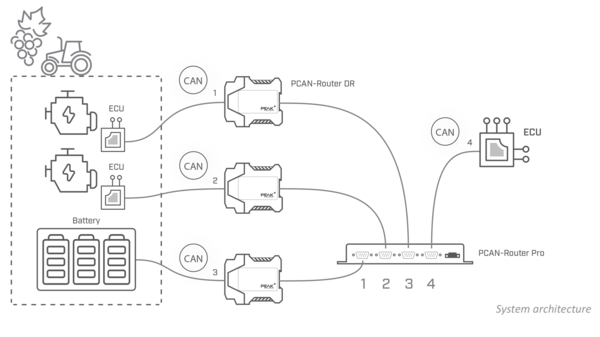
PEAK France implemented the solution in three stages. The CAN network was first rewired using shielded twisted-pair cables designed for EMC applications. The network topology was redesigned so that each ECU was connected directly to the main CAN bus, and the 120 Ω termination resistors were repositioned at both ends of the network.
PCAN-Repeater DR modules were then installed between the power controllers and the rest of the CAN network. The galvanic isolation reduced the electromagnetic disturbances generated by the power controllers and significantly decreased the number of CAN error frames. Finally, a PCAN-Router Pro was integrated to filter and route CAN messages. By ensuring that each ECU received only the messages intended for it, unnecessary network traffic was reduced, improving overall communication performance.
The communication architecture combined optimized CAN cabling, galvanic isolation, and intelligent message routing. Shielded twisted-pair cables and a corrected CAN bus topology provided a stable physical network. PCAN-Repeater DR modules electrically isolated the power controllers from the rest of the system, preventing electromagnetic disturbances from propagating across the CAN bus. The PCAN-Router Pro filtered and routed CAN traffic so that only relevant messages were delivered to each ECU, reducing bus load and minimizing the risk of communication collisions.
By redesigning the CAN network architecture and integrating the PCAN-Repeater DR and PCAN-Router Pro, PEAK France eliminated the random communication failures affecting the electric tractor. The resulting CAN network became stable, reliable, and suitable for deployment across the manufacturer’s entire range of electric tractors.
 English
 Deutsch
 Français
 Chinois 中文
 Coréen


