Nous utilisons des cookies sur notre site web afin de vous fournir le meilleur service possible et d'améliorer encore notre site web. En cliquant sur le bouton "Accepter tout", vous acceptez l'utilisation de tous les cookies. Vous pouvez limiter les cookies utilisés en cliquant sur "Accepter la sélection". Vous trouverez de plus amples informations et une option pour révoquer votre sélection dans notre politique de confidentialité.
Ces cookies sont nécessaires pour la fonctionnalité de base. Cela vous permet de vous inscrire sur notre site web et notre forum ou de commander des produits avec notre boutique en ligne.
Avec ces cookies, nous collectons des données d'utilisation anonymisées pour notre site web. Par exemple, nous pouvons voir quel contenu est intéressant pour nos visiteurs et quelles résolutions sont utilisées. Nous utilisons ces informations pour optimiser notre site web et vous offrir la meilleure expérience utilisateur possible.
plus
→ Go directly to the PCAN-Repeater DR or PCAN-Ethernet Gateway DR
Electromagnetic compatibility (EMC) testing requires reliable communication with electronic systems while ensuring that the test environment remains free from electromagnetic interference. When multiple Battery Management Systems (BMS) and lithium battery packs must be monitored simultaneously, maintaining uninterrupted CAN communication becomes particularly challenging. To address these requirements, PEAK-System France developed a communication architecture based on the PCAN-Repeater DR, PCAN-Ethernet Gateway DR, and PCAN-Explorer 7. This study presents the customer’s application, explains the communication setup, and shows how fiber optic transmission enables reliable CAN communication during EMC testing.
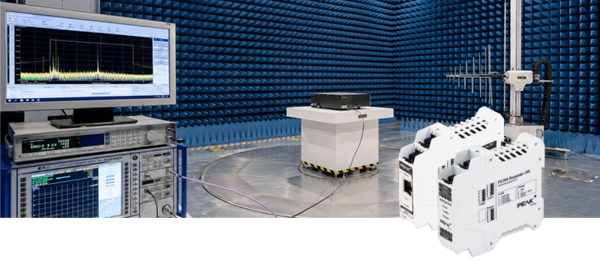
Emitec conducted electromagnetic compatibility (EMC) testing to validate multiple Battery Management Systems (BMS) and lithium battery packs simultaneously. Each BMS and battery pack communicated over its own dedicated CAN bus, resulting in a total of 12 independent CAN networks. Throughout the tests, the operator, located outside the anechoic EMC chamber, needed to monitor, analyze, and communicate with all battery packs and BMS units in real time.
The project presented two key technical challenges: First, no copper cabling could be routed between the inside and outside of the chamber, as metallic cables would interfere with EMC measurements and compromise test accuracy. Second, because each battery pack and BMS operated on a different electrical ground, galvanic isolation was required to prevent ground loops between the CAN networks.
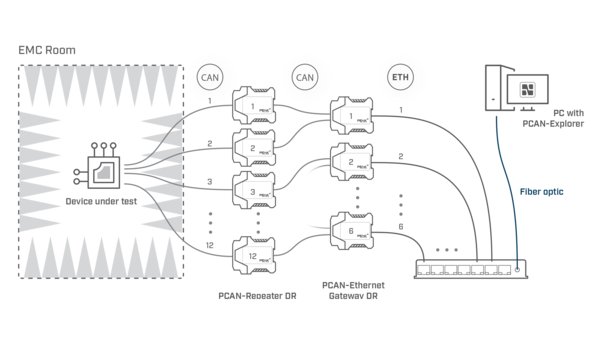
PEAK France designed a three-step communication architecture. A PCAN-Repeater DR was installed between each battery pack/BMS and the rest of the network to provide galvanic isolation, ensuring that all 12 CAN networks remained electrically independent. Each isolated CAN network was then connected to a PCAN-Ethernet Gateway DR, which encapsulated CAN frames into IP packets. As each gateway manages two CAN networks, six PCAN-Ethernet Gateway DR units were sufficient for the 12 CAN networks.
The Ethernet gateways were connected to a router using a fiber optic link that passed through the wall of the EMC chamber without affecting the tests. Outside the chamber, a second fiber optic router connected the network to the operator’s PC.
On the operator’s PC, the PEAK Virtual Gateway Driver reconstructed the 12 CAN networks. PCAN-Explorer 7 was then used to monitor and analyze CAN communication in real time. When required, firmware could also be reflashed using the integrated UDS/ISO-TP API within software developed specifically for the customer.
The solution enabled the operator to monitor and control 12 CAN networks in real time from outside the EMC chamber without interfering with EMC measurements. The architecture proved to be reliable, scalable, and reproducible for other EMC test benches.
 English
 Deutsch
 Français
 Chinois 中文
 Coréen


