We use cookies on our website to provide you with the best possible service and to further improve our website. By clicking the "Accept All" button, you agree to the use of all cookies. You can limit the cookies used by clicking on "Accept selection". Further information and an option to revoke your selection can be found in our privacy policy.
These cookies are necessary for basic functionality. This allows you to register on our website and forum or order products with our online shop.
With these cookies, we collect anonymized usage data for our website. For example, we can see which content is interesting for our visitors and which resolutions are used. We use the information to optimize our website to provide you with the best possible user experience.
show more
→ Go directly to the PCAN-PCI Express FD interface
ATESTEO, one of Germany‘s leading companies for drive-train testing, operates specialized test benches for the development and validation of modern powertrains. The focus is on electric drives, inverters, and their control units. For this purpose, the automotive testing experts use their in-house automation system, PDES. The software controls test programs, integrates measurement and actuator technology, and communicates with the devices under test under realistic conditions. For real-time execution under Windows, the automation system uses the Kithara RealTime Suite from Berlin-based real-time specialist Kithara. CAN FD communication between the test PC and the DUT ECU takes place via the integrated four-channel CAN FD interface PCAN-PCI Express FD from PEAK. This application report highlights a specific use case in which six inverters are tested simultaneously by this system in a climate chamber.
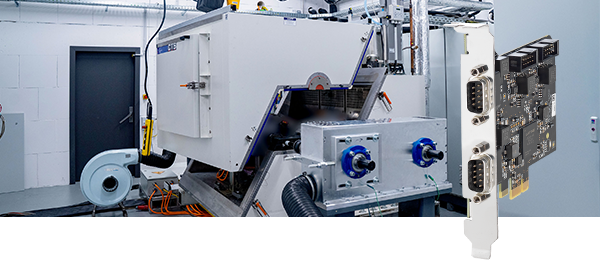
Each inverter is connected to the automation system via CAN FD. In addition, measurement, diagnostic, and calibration data are exchanged with the control units via XCP on CAN FD. Depending on the task, other participants such as battery simulators, conditioning units, sensors, actuators, and water cooling are integrated via CAN, EtherCAT, and analog or digital interfaces.
Modern test benches for electric drives don‘t test isolated components. Inverters and control units expect a realistic vehicle and system environment. They require cyclic CAN FD messages, respond to simulated operating states (residual bus simulation), and simultaneously deliver measurement and diagnostic data.
At the same time, battery, cooling, conditioning, sensors, and actuators must be reliably integrated into the test program. For this reason, the CAN-based real-time communication must maintain typical cycle times of 100 Hz, and in many applications even 1 kHz. This corresponds to reaction and processing cycles of 10 ms and 1 ms, respectively. To achieve this, ATESTEO splits the PDES system into two computers. The PDES SIU serves as the Windows front end for operation, visualization, and configuration. The PDES RTU is the isolated real-time unit that executes the test programs. On the RTU, ATESTEO uses Kithara RealTime Suite to run real-time routines under Windows, exchange data via EtherCAT, and perform CAN FD communication via the PEAK cards. User interactions, remote access, and unwanted Windows processes remain separate from the RTU.
 “We have relied on PEAK‘s CAN solutions for decades, and they have continuously proven their worth in our test benches. The PEAK hardware impresses with its reliability, stable performance, and easy integration into our test bench systems. With the latest CAN XL solutions, we are already well positioned for the next era of test bench automation.”
Horst Frantzen, Head of Software Products, ATESTEO GmbH & Co. KG
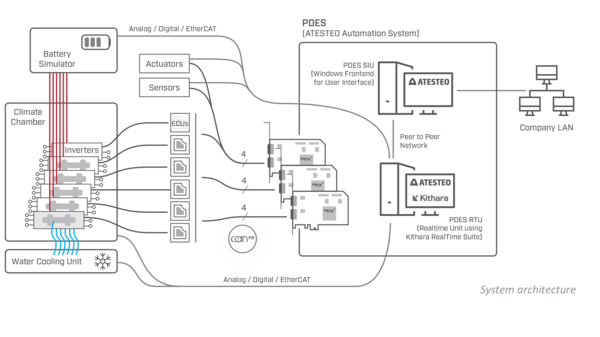
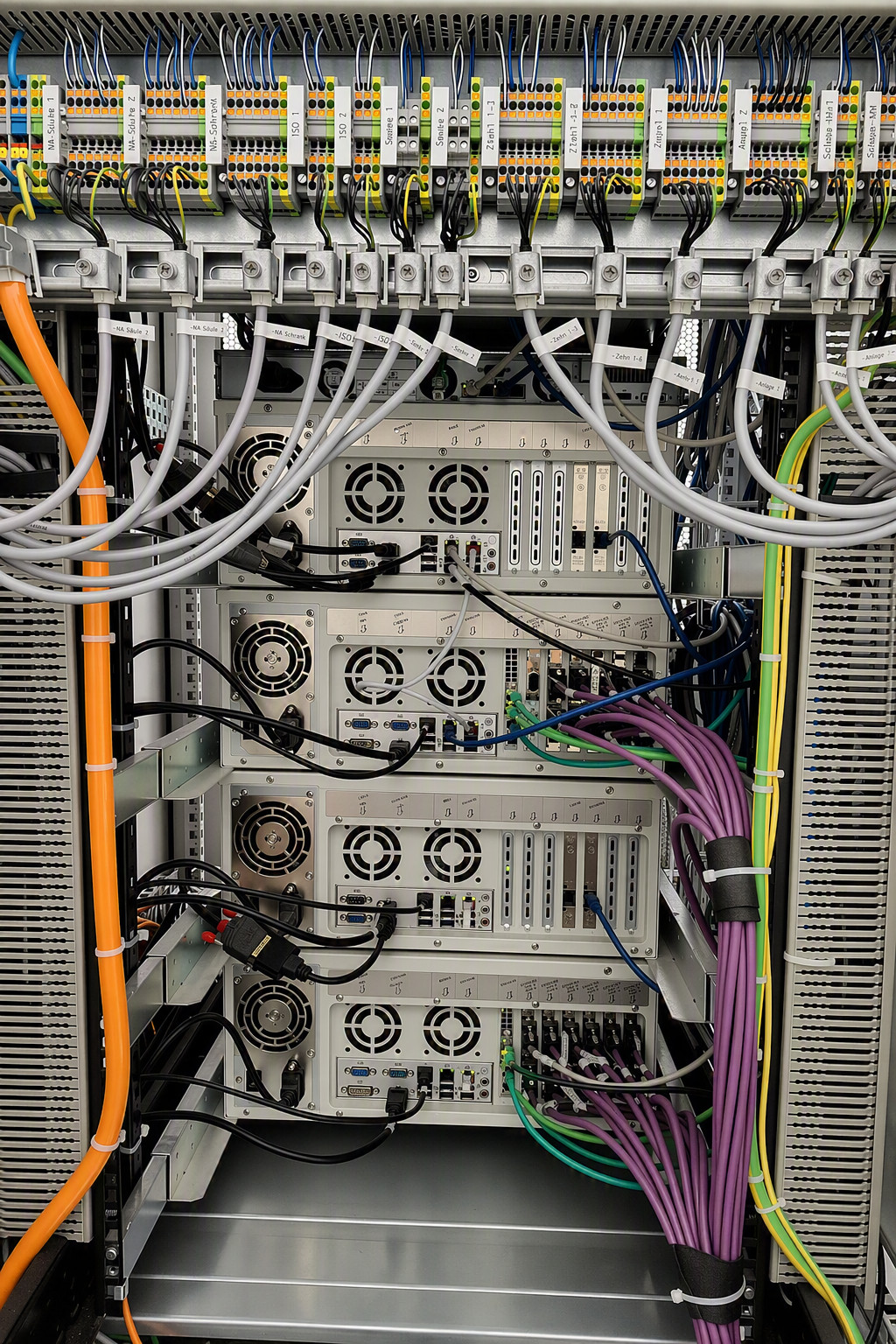 In the test bench, the six inverters are located in the climate chamber. CAN FD lines run from the automation cabinet to the test environment, connecting the RTU to the inverters‘ control units. The PDES SIU and the PDES RTU communicate via a peer-to-peer network. The SIU can be connected to the corporate network, while the RTU, as an isolated working machine, executes the test program logic deterministically. The PCAN-PCI Express FD card serves as the RTU‘s central CAN FD interface. In typical test benches, ATESTEO uses up to four four-channel cards, providing up to 16 CAN nodes. For the inverter setup described here, three sets of four CAN FD nodes are provided. Communication includes cyclic CAN FD messages, residual bus and environment simulation, as well as XCP-based data transmission.
For testing specialists, three key characteristics of the PCAN-PCI Express FD card are particularly relevant: high-performance CAN FD communication with up to 64 data bytes per frame, support for both CAN FD and classic CAN, and galvanic isolation between the PC and CAN sides. This allows both existing and new generations of control units to be operated within the same automation architecture. At the same time, the galvanic isolation increases robustness in an environment with power electronics, inverters, and extensive test bench peripherals. The PEAK hardware is also an important building block for Kithara. Kithara RealTime Suite requires a reliable low-level connection to the CAN interface so that real-time communication can be integrated directly into the Windows-based automation environment.
 “CAN XL is the logical next step for us in automotive real-time communication. That‘s why we are integrating the standard into Kithara RealTime Suite at an early stage, working together with PEAK and ATESTEO to shape the technological foundation for the next generation of test bench and control unit systems.”
Marcel Haß, Head of Technical Department, Kithara Software GmbH
The current application demonstrates what is already being achieved productively with CAN FD: parallel communication with multiple inverters, XCP data exchange, deterministic execution of test programs, and integration of additional test bench components. At the same time, the requirements for future generations of control units are increasing. Higher data rates, larger payloads, and more powerful communication structures are becoming more important. This is why PEAK, Kithara, and ATESTEO are already working on integrating CAN XL. ATESTEO plans to incorporate CAN XL into PDES in order to test upcoming generations of control units under realistic test bench conditions. Kithara RealTime Suite is being extended with new CAN standards such as CAN XL and CAN FD light. PEAK provides the hardware foundation, low-level documentation, and interface technology for this. All three companies are thus positioning themselves as pioneers for CAN XL in test bench automation.
 English
 Deutsch
 Français
 Chinese 中文
 Korean


